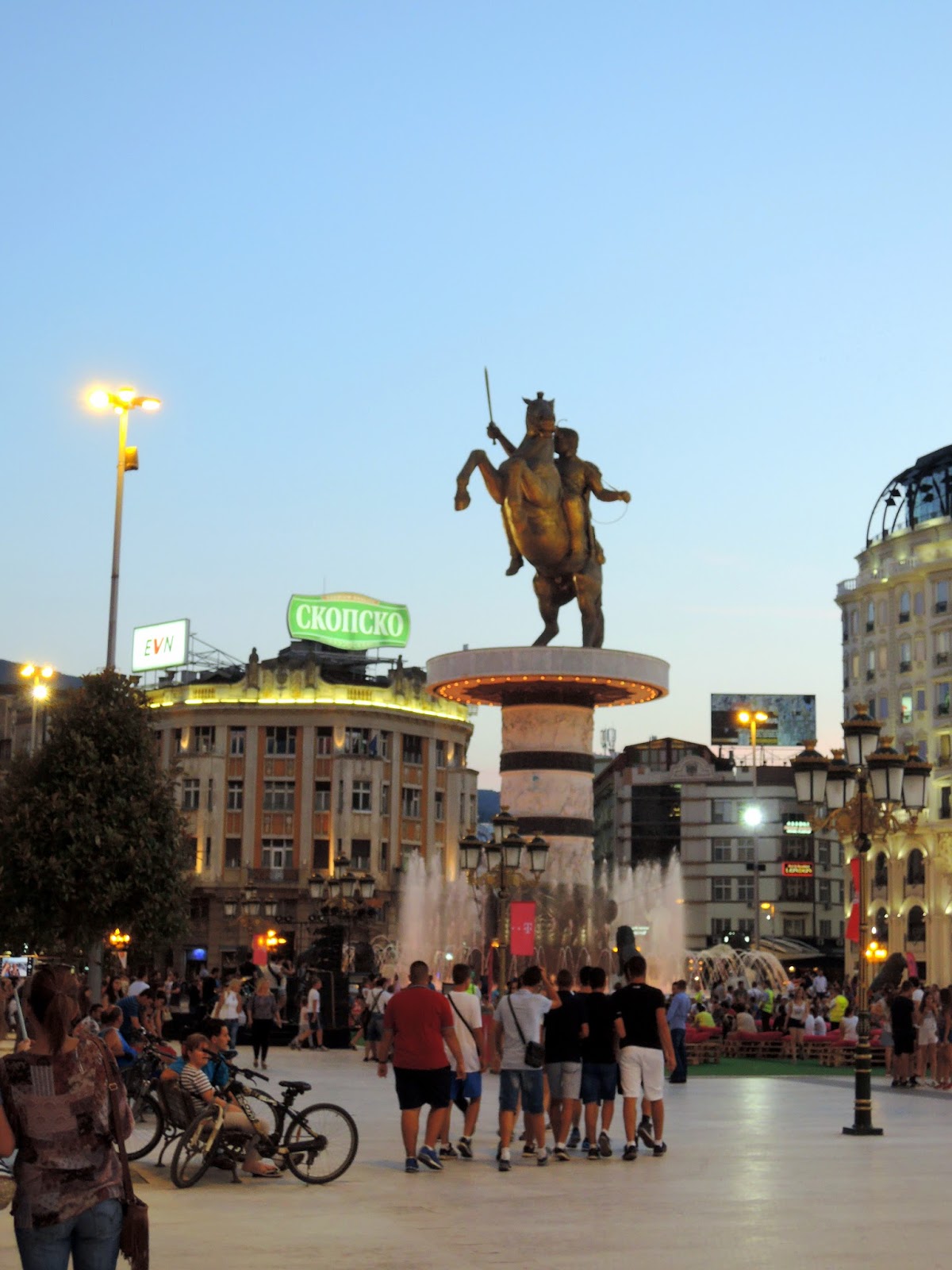
July 10-14
I *heart* Macedonia.
If I had only visited Skopje, I would have felt that way. However, after taking a 2 day detour to a village on a lake, I realized that love the country even that much more.
Ohrid is NOT Skopje. We're talking night and day here.
So here's what you need to know.
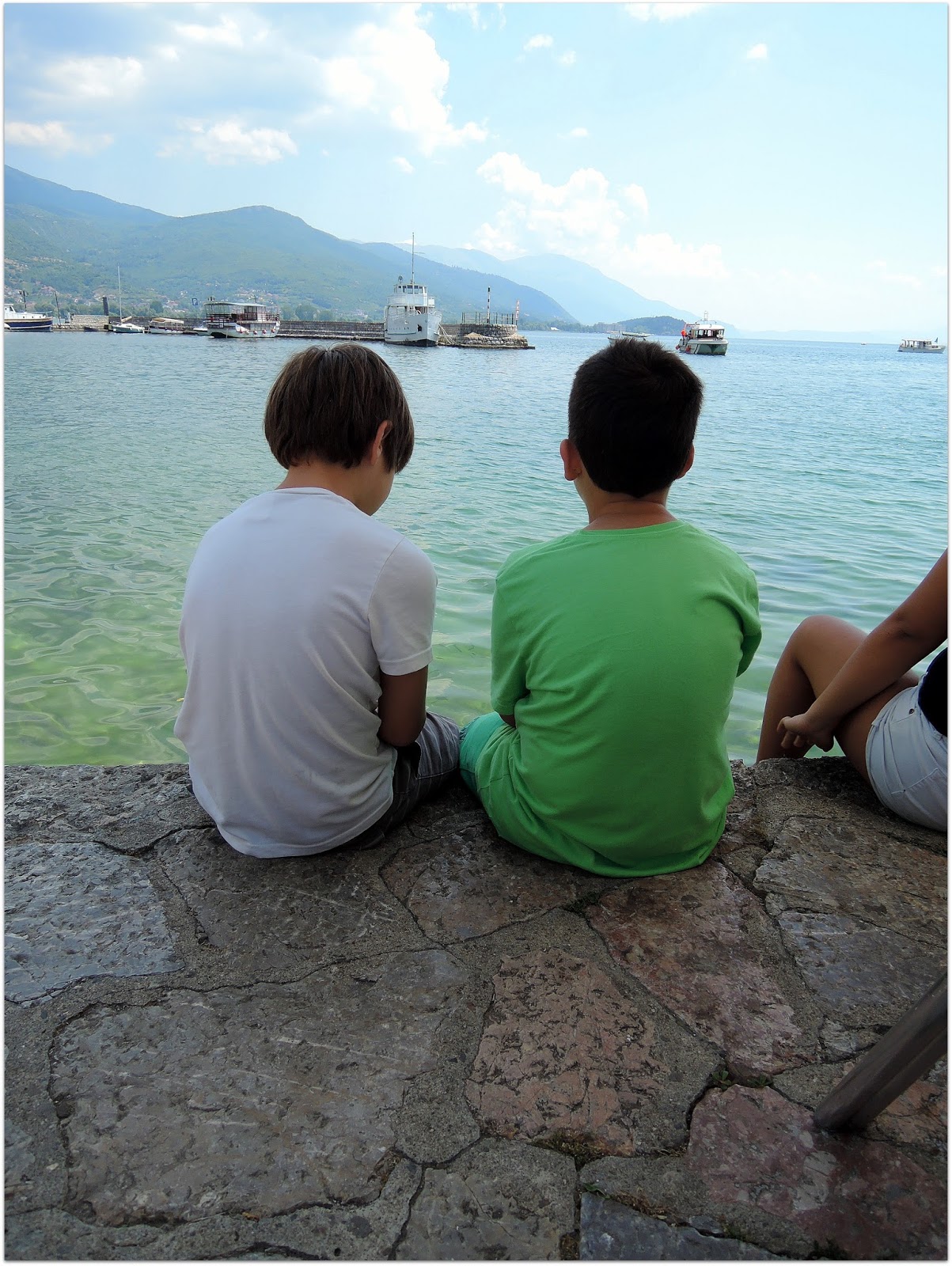 |
| two happy boys looking over Lake Ohrid |
Lake Ohrid is one of the oldest lakes in the world, and THE oldest lake in Europe. Think about that for a moment! Two-thirds of it in is located in Macedonia and the other 1/3 in Albania.
We visited the town of Ohrid on the Macedonian side of the lake. It is a thriving resort town in the summer time, with small hotels, boutique and tourist shops, sidewalk cafes, and restaurants. I had read that it is very crowded during summer vacation season, but either we were a little early for the big crowds, or the crowds we encountered weren't that big. In addition to the beautiful lake, Ohrid is most notable for once having 365 churches, one for every day of the year. It is built on hills and cliffs over the lake, requiring quite a bit of walking and hiking if you want to see it all, and with some foot trails barely wide enough for 2 people.
Also, to answer why Ohrid?---if you didn't quite catch my last post, Macedonians are very proud of their country and their history. My host and her sister love the peaceful, historical atmosphere and were passionate about us experiencing this beautiful little town. I'm so happy we did.
The Ohrid region has the rare distinction of being both an UNESCO Natural and Cultural site. The lake itself is between two and three MILLION years old and hosts unique species of fish and fauna. The town of Ohrid is one of the oldest settlements in Europe and archeologists have excavated basilicas from as old as the 4th and 5th centuries. The village is known for its masonry and many ancient homes that have been excavated exhibit beautiful mosaic work. Many current homes are from the 18th and 19th centuries. Some of my friend's family have lived in Ohrid for generations, and during a renovation of their house, found mosaics and artifacts dating back thousands of years.
Getting there
 |
| on the road again. . . |
We hit a large rest area about half way there that had a gas station, small restaurant, and another walk-up restaurant across the street. Many tour busses had stopped in the area, and as in much of Macedonia, stray dogs were around waiting for a snack or two.
 |
The grown ups went for some Nespresso (it's instant coffee, with George Clooney as the spokesperson, and big all over Europe) and also some fresh pastries. That's when I had one of those really, really weird other-worldly moments you sometimes have when traveling. Drinking my coffee and chowing down on carbs, I heard some blues music. Some familiar blues music. Then I realized the music I was listening to was none other than Stevie Ray Vaughn. Basically we are sitting in the middle of nowhere, Macedonia, eating pastries and cheap gelato and sipping Nespresso and listening to one of Texas' favorite sons.
About that time, we also decided to pick up two hitchhikers (sort of sounds like the start to a horror movie, right?). No worries, hitchhiking is relatively safe in Europe and these were two college students who were trying to make their way across all the Balkan states, mostly by hitching rides. We finally got to Ohrid, had a beer together with the extra travelers, speaking enough of a combination of Slovenian, Macedonian, and English to understand each other, and then went our separate ways.
Sveti Sophia dates from the 6th century. During the Turkish rule of the area, the church was converted into a mosque and the Christian frescoes were covered. The Turks also added architecture representative of their culture that still exists today. We were not allowed to take pictures inside, but we did see the frescoes that are slowly being uncovered and repaired as the mosque became a church again. The restoration is a work in progress, but the building is in amazing shape to be so ancient. We also saw evidence from WW2 Nazis who came through and carved the German cross into the pillars of the church. (Stupid Nazis).

In addition to Sveti Sophia, we walked the long, winding, arduous hill to the highest part of the town to see St. Jovan of Kaneo Monastery. With its gorgeous Byzantine architecture and views, it was worth the hike (even if my kid complained the ENTIRE TIME). It was founded in the 13th century.

The basket by the door to the monastery says, "If you wearing shorts top short skirt please put on a wrap from the basket. Thank you for respecting the holiness of the church."
We spent the rest of the day sightseeing, eating, and window-shopping. There were beautiful freshwater pearls and artwork; more gelato, pizza, and amazing cheeses; more stray dogs to pet and lots of turtles all over the place; people walking on the lakeshore front and eating on sidewalk cafes.
We had a wonderful meal for three children and four adults that consisted of several entrees (we ordered extra so I could sample typical Macedonian cuisine), appetizers and salads, drinks, and a dessert. The total came to $60. That's for EVERYTHING. Can you believe it? Hotels are also very reasonable (and unlike lots of European hotels, they are air conditioned). There were lots of choices of restaurants, including many outdoor options so we could take advantage of the beautiful weather, and the kids had a great time feeding the fish on the waterfront.
Ohrid seems like a great getaway for people of all ages. We saw young and old families, families on bikes and walking with strollers, little children on tricycles. We saw several Muslim families---blonde, blue-eyed, Albanian Muslim families. I didn't see very many Americans, although we met a Macedonian couple who live in Florida, and they have lived in the U.S. for over 20 years. They were visiting Ohrid on vacation because it's their favorite place to go while back home.

What I learned:
Overall, I loved visiting a town full of ancient history to balance out a city that is still, in many ways, trying to find its history and identity. As far as going to a town of churches, I found the experience very peaceful, even if I didn't grow up in a faith with saints and I'm desperately trying to remember what little I know about them when my youngest asks, "who is that guy?" or "why is that church named for that person?" But nobody thought I was a heathen when I asked, thankfully, and my saint confusion was the constant theme of all my church visits in Europe.
I had a great moment meeting Ana's aunt, who is also a librarian. The word for librarian in Macedonian is very close to the word in Spanish, bibliotecaria. The word for library is close to the word biblioteca. I said something about the words must have the same Greek root, but was quickly told that no, Macedonian does NOT have words from Greek. Those Greeks, again! They can't have the country name, or claim Alexander as all their own, or get the credit for the Macedonian language (even if it is only a few words). Macedonians are independent (and don't you forget it).
I know I'm showing my American-ness, but I just can't get over how old things are in this area. When the Mayans were just starting to build Chichen Itza, some of these churches had already been in use for generations. Walking around Ohrid, you see lots of modern cars (and many mopeds), but you know what else you see? Yugos. Remember Yugos? They are EVERYWHERE, and seeing so many of them in use made me smile. That's sort of like Ohrid. There is enough modern to catch your attention---great modern restaurants and hotels---but overall, there's a nostalgia that holds it all together.
On the way to Ohrid I also couldn't help but notice the many, many villages which all had mosques in the center. This is Muslim country in Macedonia. Many Muslims of Albanian background live in this part of the country, and Albania, unlike Macedonia, is a majority Muslim country.
What to do and see
When you are in a town of 365 churches, obviously you are going to see churches.
When you are in a town of 365 churches, obviously you are going to see churches.
 |
| St. Sophia (Sveti Sophia) |

In addition to Sveti Sophia, we walked the long, winding, arduous hill to the highest part of the town to see St. Jovan of Kaneo Monastery. With its gorgeous Byzantine architecture and views, it was worth the hike (even if my kid complained the ENTIRE TIME). It was founded in the 13th century.

The basket by the door to the monastery says, "If you wearing shorts top short skirt please put on a wrap from the basket. Thank you for respecting the holiness of the church."
 |
| one of many tiny churches on our hike around Ohrid |
We spent the rest of the day sightseeing, eating, and window-shopping. There were beautiful freshwater pearls and artwork; more gelato, pizza, and amazing cheeses; more stray dogs to pet and lots of turtles all over the place; people walking on the lakeshore front and eating on sidewalk cafes.
We had a wonderful meal for three children and four adults that consisted of several entrees (we ordered extra so I could sample typical Macedonian cuisine), appetizers and salads, drinks, and a dessert. The total came to $60. That's for EVERYTHING. Can you believe it? Hotels are also very reasonable (and unlike lots of European hotels, they are air conditioned). There were lots of choices of restaurants, including many outdoor options so we could take advantage of the beautiful weather, and the kids had a great time feeding the fish on the waterfront.
Ohrid seems like a great getaway for people of all ages. We saw young and old families, families on bikes and walking with strollers, little children on tricycles. We saw several Muslim families---blonde, blue-eyed, Albanian Muslim families. I didn't see very many Americans, although we met a Macedonian couple who live in Florida, and they have lived in the U.S. for over 20 years. They were visiting Ohrid on vacation because it's their favorite place to go while back home.

Overall, I loved visiting a town full of ancient history to balance out a city that is still, in many ways, trying to find its history and identity. As far as going to a town of churches, I found the experience very peaceful, even if I didn't grow up in a faith with saints and I'm desperately trying to remember what little I know about them when my youngest asks, "who is that guy?" or "why is that church named for that person?" But nobody thought I was a heathen when I asked, thankfully, and my saint confusion was the constant theme of all my church visits in Europe.
I had a great moment meeting Ana's aunt, who is also a librarian. The word for librarian in Macedonian is very close to the word in Spanish, bibliotecaria. The word for library is close to the word biblioteca. I said something about the words must have the same Greek root, but was quickly told that no, Macedonian does NOT have words from Greek. Those Greeks, again! They can't have the country name, or claim Alexander as all their own, or get the credit for the Macedonian language (even if it is only a few words). Macedonians are independent (and don't you forget it).
I know I'm showing my American-ness, but I just can't get over how old things are in this area. When the Mayans were just starting to build Chichen Itza, some of these churches had already been in use for generations. Walking around Ohrid, you see lots of modern cars (and many mopeds), but you know what else you see? Yugos. Remember Yugos? They are EVERYWHERE, and seeing so many of them in use made me smile. That's sort of like Ohrid. There is enough modern to catch your attention---great modern restaurants and hotels---but overall, there's a nostalgia that holds it all together.